
Custom Fabricated Steel Truss + Bailey Modular Truss Combined Span Bridge: Integrated Solution for DPWH, Philippines
Oct 26, 2026
1. Why Combined Span Bridges Fit the Philippine Infrastructure Context
The Philippines lies within the western Pacific typhoon belt, struck by around 20 typhoons annually. Torrential monsoon rains frequently trigger river flooding and landslides, while its location on the Pacific Ring of Earthquakes brings persistent seismic risks. These hazards repeatedly damage and cut off provincial and national highway bridges. As the national authority for road assets, the Department of Public Works and Highways (DPWH) faces a dual challenge: restoring vital transportation corridors rapidly after disasters, and delivering structures capable of long-term permanent service.
Conventional Bailey bridges excel at emergency deployment but have limitations on design service life and heavy load capacity. Fully welded custom steel trusses meet permanent design requirements yet demand longer fabrication and erection schedules, which are not ideal for urgent rescue scenarios. Our combined span concept integrates custom fabricated welded steel trusses and 321 / HD200 modular Bailey bridge. This hybrid configuration fills the gap between emergency rapid restoration and permanent highway construction, supporting a phased construction strategy: open traffic first, then upgrade the structure gradually.
2. Product Composition: Synergy of Two Truss Systems
2.1 Modular Bailey Bridge(321 & HD200 Series) for Emergency Opening
321 and HD200 Bailey panels are standardized pin-connected modules. They can be transported in compact packages and assembled with limited lifting equipment. This proven modular system enables fast erection for temporary traffic restoration, which is critical for disaster response and detour works across remote Philippine sites.
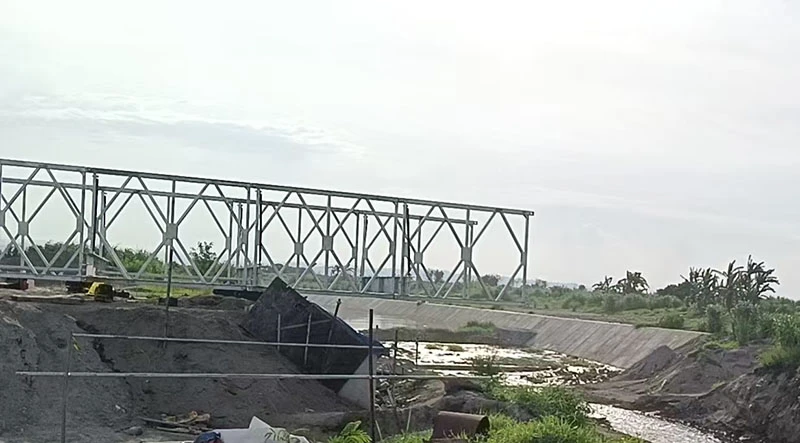
A representative reference is our completed project in Mabalacat, Pampanga. The project features a total bridge length of 33.528 meters, adopting HD200 standard Bailey panels as the primary load-bearing truss system, a mature product line independently developed by Great Wall complying with AASHTO and Eurocode standards. To satisfy local industrial pipeline transportation demands, a 2.6-meter-wide external pipeline beam was specially customized and mounted on the bridge side. The entire bridge structure, including all bailey panels, transoms, railings and pipeline brackets, undergoes full hot-dip galvanizing treatment. The construction team applied the launching method (push-out installation) for whole-span erection, eliminating the need for full-space temporary support under the river channel and greatly adapting to the narrow construction site in Mabalacat. This HD200 single-span implementation demonstrates how modular Bailey components can be engineered with custom attachments and advanced erection techniques, forming the core modular segment of our hybrid combined-span scheme.
2.2 Custom Fabricated Welded Steel Truss for Permanent Main Spans
For long-span and heavy-duty permanent sections, factory-welded steel trusses are engineered to tailored span lengths, roadway widths and deck systems. Fabricated from high-grade structural steel, these primary load-carrying members comply with DPWH provisions and AASHTO LRFD load combinations for long-term highway operation.
2.3 Core Advantages of the Combined Span Design
Transition connections are engineered to match the interface geometry and load transfer between welded truss sections and Bailey modules. The welded truss segments serve as permanent primary superstructure, while Bailey modules function as quickly deployable temporary spans. The whole scheme supports staged investment: restore connectivity in days, then replace Bailey sections with permanent steel components later without demolishing the already completed substructure.
3. Engineering Design Adapted to Philippine Climate and Geographical Conditions
3.1 Adopted Design Standards
All structural calculations follow AASHTO LRFD and DPWH bridge design standards. Load cases include dead load, live load (T44 / T66 vehicle loading), typhoon wind load, flood scour, seismic load and temperature effects. Complete structural calculation reports and drawings are available for DPWH review and approval.
3.2 Environmental Adaptation
High temperature and high humidity: Thermal expansion and contraction are calculated and accommodated in bearing and joint design;
Coastal salt spray corrosion: Heavy-duty anti-corrosion coating system is specified to resist marine atmospheric corrosion for coastal islands;
Complex island and mountain terrain: Split modular packages suit inter-island shipping and narrow-site erection with limited heavy machinery.
4. Traceable Full-Scope Welding Quality Control
4.1 Welding Management Plan
A formal Welding Management Plan is implemented in accordance with AWS D1.1 / D1.5. The plan defines control procedures for material receiving, welding execution, in-process inspection, non-destructive testing and repair activities.
4.2 WPS Supported by PQR & WPQR
Every Welding Procedure Specification (WPS) is qualified by Procedure Qualification Records (PQR / WPQR). Only approved, qualified procedures are released to production. All welders and welding operators hold valid qualification certificates matching the applicable welding processes and material groups.
4.3 Full Lifecycle Traceability
We maintain traceability records covering base metal, consumables, heat input, preheat temperature, interpass temperature, NDT results and repair history. Every critical weld can be tracked back to raw material batches, welding personnel and process parameters.
5. Core Value Proposition for DPWH
This hybrid combined span solution delivers fast emergency reopening, flexible phased construction, consistent standard compliance and convenient maintenance. It aligns perfectly with DPWH's needs for disaster-resilient highway networks across the Philippine archipelago.
FAQ
Q1: What is the difference between a combined span bridge and a standard Bailey bridge?
A standard Bailey bridge is generally designed for temporary use. Our combined span bridge mixes permanent custom welded trusses and modular Bailey sections. It supports rapid emergency opening and can be upgraded into a permanent highway bridge in later phases.
Q2: Can the design comply with DPWH and AASHTO LRFD requirements?
Yes. Structural analysis, load combinations and detailing follow AASHTO LRFD and DPWH bridge specifications. We can submit full design packages for review.
Q3: How is corrosion resistance guaranteed under Philippine typhoon and salt spray conditions?
We perform wind and seismic load combinations for typhoon-prone zones and adopt heavy-duty protective coating systems to mitigate salt spray corrosion for coastal projects.
Q4: What is the typical erection timeline?
Bailey emergency sections can be assembled and opened to traffic within several days. The erection schedule for welded permanent truss segments depends on span arrangement and site conditions.
Q5: Can the temporary Bailey segments be replaced later for permanent upgrade?
Yes. Standardized transition connections are reserved. Temporary Bailey modules can be removed and substituted with permanent welded trusses while retaining the existing substructure.
Q6: How is welding quality controlled and traced?
Welding activities are governed by the Welding Management Plan. WPS is qualified by PQR/WPQR; welders hold valid qualifications. Base metal, welding consumables, heat input, preheat, interpass temperature and repair works are fully traceable.